
Almost 50 Years On, Voyager 1 Is Still Transmitting From Interstellar Space – And Amateur Astronomers From The Netherlands Just Picked Up Its Signals

NASA
In today’s age of space travel, in which multiple objects are launched from our planet almost every day, the idea that we could one day all take a trip into the solar system seems quite normal.
But just fifty years ago, things were very different. Sure, man had been to the moon, but to the everyday citizen of Earth, space felt very, very far away.
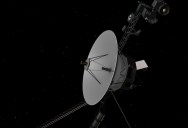
NASA’s Voyager 1 spacecraft was launched back in September 1977, in a very different technological landscape. In its five-year expected lifespan, Voyager 1 was to send close-ups of Jupiter and Saturn back to Earth.
Little did the scientists and engineers know at the time, Voyager 1 would – against all odds – still be transmitting data back to Earth in the year 2026, from outside of the heliosphere.
NASA/JPL-Caltech
Of course, Voyager 1 has not massively outperformed its intended goals, giving scientists back home on Earth a greater understanding not only of Jupiter and Saturn, but of interstellar space too.
In fact, according to a NASA article, Voyager 1 has been at the helm of significant discoveries, including Jupiter’s ring and Thebe and Metis, two of the planet’s moons, and five new moons and a new ring around Saturn too.
Of course, the spacecraft is getting very old now, and is understandably facing some technical difficulties. In fact, several of Voyager’s instruments have been shut down to conserve fuel and help it to prioritise certain observations.
And given Voyager 1 is the first human-made object to exit the heliosphere and travel into interstellar space, where it is now over a light day away from Earth, it’s understandable that communication is becoming increasingly difficult.
NASA/JPL-Caltech
So imagine the surprise of amateur astronomers in the Netherlands when a signal they picked up using the Dwingeloo radio telescope recently was none other than Voyager 1!
And it’s not the first time either. In fact, the amateur Radio in Space (AMSAT) group have received communications from Voyager 1 no less than three times – once in 2006, then in 2024, and again more recently – though, as Dwingeloo volunteer Thomas Telkamp explained at the AMSAT symposium, the signals are telling of the distance and deterioration of the spacecraft:
“In all these years, Voyager has traveled a lot of distance, so the signal is really weaker at this point than it was years ago.”
Sure, Voyager 1 is getting quieter and its instruments and communications are shutting down, but let’s hope that the spacecraft has a little life still left in it.
Keep going Voyager 1, you got this!
If you thought that was interesting, you might like to read about why we should be worried about the leak in the bottom of the ocean.





Sign up to get our BEST stories of the week straight to your inbox.
