
James Webb Space Telescope Helps Gather Information About Extremely Rare Planetary-Mass Floating Through Interstellar Space

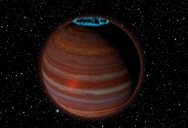
Chuck Carter, Caltech, NRAO/AUI/NSF
There is an object flying through space about 20 light-years from Earth that has intrigued astronomers for quite a while. It was first spotted back in 2006 and has been analyzed using a variety of different tools, including the Hubble Space Telescope and the Spitzer Space Telescope. As with most things in science, it has a long and weird name (SIMP J013656.5+093347), but it is just called SIMP0136 by most people.
It is about 14 times more massive than Jupiter, which puts it in a weird position where astronomers don’t know for sure if it is a brown dwarf star or a very large planet. For the moment, they generally refer to it as a planetary mass.
Recently, the James Webb Space Telescope was used to analyze the object and see what more could be learned from its more advanced instruments.
Shutterstock
The infrared light observation tools picked up data that suggests that the planet has a complex atmosphere and possibly cloud layers. There are also temperature shifts in its atmosphere, and maybe auroras. They published their findings in the journal The Astrophysical Journal Letters.
In a NASA statement, the lead author of the study, Allison McCarthy, said:
“We already knew that it varies in brightness, and we were confident that there are patchy cloud layers that rotate in and out of view and evolve over time. We also thought there could be temperature variations, chemical reactions, and possibly some effects of auroral activity affecting the brightness, but we weren’t sure.”
Adding the new information collected from the James Webb telescope to the existing body of knowledge will help researchers to generate new insights into this very rare object. While it is very unlikely that we will ever visit it or that it has life on it, having the opportunity to study this type of thing is very helpful.
Shutterstock
The methods used to learn more about SIMP 0136 can be used in the future when analyzing other planets, including those that may be home to life.
Having the ability to spot an object traveling rapidly through space, then track it and study it for decades, is a testament to the astronomical community. As new and advanced technology is developed, we will undoubtedly learn more about this mysterious ‘planetary-mass’.
If you thought that was interesting, you might like to read about a second giant hole has opened up on the sun’s surface. Here’s what it means.





Sign up to get our BEST stories of the week straight to your inbox.
