
New Model Explains Limiting Factors To Life On Saturn’s Moon, Titan

NASA/JPL-Caltech/University of Nantes/University of Arizona
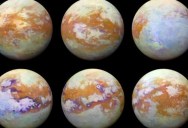
In just over three years time, NASA’s Dragonfly rotorcraft is set to launch on a long mission to Saturn’s moon, Titan.
Scheduled to reach Titan’s surface in 2034, the mission aims to explore the moon and look for any signs of life.
That’s because Titan is thought to have Earth-like conditions on its surface, with oceanic qualities inside.
However, since Titan has a very thick atmosphere, and its composition is more liquid methane than water, more ice and soot than rocks and sand, the real livability of the planet’s conditions have long been under debate.
But now, a new study from researchers at the University of Arizona have uncovered more about what truly lies in wait for Dragonfly, and whether life really is viable on Titan.
Antonin Affholder, from the University of Arizone, co-led the study alongside Peter Higgins from Harvard University. In a statement about the work, Affholder explained that while the organic matter known to be present on Titan could present the possibility for life, there are other factors that limit that life’s progress:
“In our study, we focus on what makes Titan unique when compared to other icy moons: its plentiful organic content. There has been this sense that because Titan has such abundant organics, there is no shortage of food sources that could sustain life. We point out that not all of these organic molecules may constitute food sources, the ocean is really big, and there’s limited exchange between the ocean and the surface, where all those organics are, so we argue for a more nuanced approach.”
NASA/Johns Hopkins APL/Steve Gribben
In the study, which has been recently published in The Planetary Science Journal, the team used bioenergetic modeling to explore Titan’s ocean.
With the understanding that the ocean could be 300 miles deep, the team found that while conditions are such to support simple lifeforms, they restricted that life becoming abundant.
The main factor prohibiting the acceleration of life on Titan is a lack of molecules for life forms to consume. Because there is a lack of oxygen in Titan’s ocean – where life, if it exists, is thought to be – any microorganisms would have to survive through fermentation instead of respiration.
This isn’t unusual – after all, it is thought that Earth’s early life forms followed a similar process, so the team explored the potential for a particular amino acid, glycine, to kick-start life on Titan, as Affholder continued:
“We asked, could similar microbes exist on Titan? If so, what potential does Titan’s subsurface ocean have for a biosphere feeding off of the seemingly vast inventory of abiotic organic molecules synthesized in Titan’s atmosphere, accumulating at its surface and present in the core?
We know that glycine was relatively abundant in any sort of primordial matter in the solar system. When you look at asteroids, comets, the clouds of particles and gas from which stars and planets like our solar system form, we find glycine or its precursors in pretty much all those places.”
NASA/JPL-Caltech
Sadly for those hoping to find advanced life on Titan though, the models suggested that – thanks to the icy surface of Titan’s oceans – very little glycine would be able to permeate the ocean from Titan’s surface, so any microbes hoping to consume it would find themselves perpetually hungry.
Though it’s certainly not a firm no to the discovery of life on Titan, the researchers suggest that any microbial life would be extremely hard to find, owing to the fact that it would be both extremely small, elusive, and so low in numbers that finding it in all that ocean would be a miracle.
If you thought that was interesting, you might like to read about a quantum computer simulation that has “reversed time” and physics may never be the same.





Sign up to get our BEST stories of the week straight to your inbox.
