
Researchers Point The James Webb Space Telescope At The Black Hole At The Center Of Our Galaxy And Discover Something Very Unusual

Shutterstock
The James Webb Space Telescope is known for being able to see deep into space, providing scientists (and us) with some of the most incredible images from distant galaxies.
When scientists at Northwestern University were given access to the space telescope, however, they took a different approach. Rather than looking at things that were extraordinarily far away, they turned the telescope toward the center of our own galaxy.
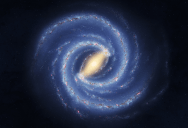
Specifically, they wanted to look at Sagittarius A, which is the black hole at the center of the Milky Way. While it is still 26,000 light-years away from us, that is almost nothing compared to the billions of light years the telescope has been used for in the past.
So, what did they see?
Shutterstock
According to a CNN report, they witnessed some amazing flares of light coming from the black hole, which were described by viewers as similar to pyrotechnics.
The researchers took the data that they gathered and wrote a new paper, which was published in The Astrophysical Journal Letters. In the paper, they explain that these flares of light are normally found at accretion disks or else coming from disks of hot gas.
The team is not yet sure of the exact origin, though they suspect that it may actually be from an accretion disk that is just past the event horizon of the black hole.
Farhad Yusef-Zadeh is a physics and astronomy professor at Northwestern University and was the lead author of the paper. He said to CNN:
“In our data, we saw constantly changing, bubbling brightness. And then boom! A big burst of brightness suddenly popped up. Then, it calmed down again. We couldn’t find a pattern in this activity. The activity profile of this black hole was new and exciting every time that we looked at it.”
Black holes are pretty mysterious, though they have been studied extensively for decades now. Scientists are constantly learning more about them, largely based on how they impact the area around them since even light can’t escape from the black hole itself.
Shutterstock
Yusef-Zadeh goes on to comment about how even for black holes, this type of activity is very unusual.
“Flares are expected to happen in essentially all supermassive black holes, but our black hole is unique. It is always bubbling with activity and never seems to reach a steady state.”
Additional research will undoubtedly be done to try to find an explanation. This is particularly exciting because this black hole is the closest to Earth, which means researchers will be able to get the most accurate information possible.
The team did not say whether they would be using the James Webb Space Telescope to gather additional information or if other tools would be used.
Whatever the case, it is amazing to learn that even among the many oddities in space, our black hole seems to be unique in its behavior.
If you thought that was interesting, you might like to read about a second giant hole has opened up on the sun’s surface. Here’s what it means.





Sign up to get our BEST stories of the week straight to your inbox.
