
Unusual And Unexpected Rock Formations Found By The NASA Perseverance On Mars

NASA/JPL-Caltech
The NASA Perseverance Rover has been rolling along the surface of the red planet for quite some time, often sending back surprising and unexpected data.
It was recently sent to an area dubbed Broom Point, which is located in the “Witch Hazel Hill” area because NASA identified several light and dark areas from a satellite and wanted to get a closer look. NASA explained:
“Orbital views of Witch Hazel show layered materials that likely date from a time when Mars had a very different climate than today. Those views have revealed light-toned bedrock similar to what was found at ‘Bright Angel,’ the area where Perseverance recently discovered and sampled the ‘Cheyava Falls’ rock, which exhibits chemical signatures and structures that could possibly have been formed by life billions of years ago when the area contained running water.”
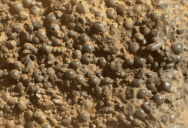
All the fun names that have been given to these areas aside, when the rover arrived, they found something unexpected. Some of the rocks on the rim of a crater seem to be made up of small spherical-shaped objects, which were previously dubbed ‘blueberries’ due to their bluish tones and rounded shape.
Shutterstock
In an update from NASA, Alex Jones, Ph.D. candidate at Imperial College London said:
“Some of these occurred as more elongate, elliptical shapes, while others possessed angular edges, perhaps representing broken spherule fragments. Some spheres even possessed tiny pinholes!”
Experts do not yet know what caused the rocks to form this way, though there are some theories. Jones explained:
“In each of these cases, the spherules were interpreted as concretions, features that formed by interaction with groundwater circulating through pore spaces in the rock. Not all spherules form this way, however. They also form on Earth by rapid cooling of molten rock droplets formed in a volcanic eruption, for instance, or by the condensation of rock vaporized by a meteorite impact.”
Shutterstock
The rover was able to snap good pictures of them, and gather other details as well, which were sent back to Earth. Scientists continue to study them to try to come up with ideas as to what might cause this type of rock formation on Mars.
Martian surprises are always interesting.
If you thought that was interesting, you might like to read about a second giant hole has opened up on the sun’s surface. Here’s what it means.





Sign up to get our BEST stories of the week straight to your inbox.
