
Wandering Planet’s Collision With Ancient Earth Probably Gave Us The Moon

NASA
Our moon is a particularly unusual example of moons when it comes to planetary bodies. Though many other planets in the solar system have moons, they are very different from our own. Most planets have moons far smaller in scale than ours is compared to Earth. And other big moons in our solar system boast ice or atmospheres on their surface, while ours is desolate.
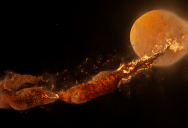
Part of the reason our moon is so different is that it likely did not form in the same manner as most moons. Instead, our moon is the result of a wandering planet’s collision with a very ancient Earth over four billion years ago.
NASA
This wandering planet is known as Theia, and it was thought to be about the size of Mars. When Earth and Theia collided, the impact destroyed the smaller planet, sending up vast amounts of debris from both bodies that eventually coalesced into our incongruously large moon.
The size of the Moon has had a huge impact on Earth’s development, shielding us from many other collisions that might have halted the development of life and also being responsible for the tides, which may have had a hand in the evolution of early ocean life.
Moon samples brought back from Apollo missions greatly enhanced our understanding of the Moon’s unusual formation and helped us to understand when and how it formed.
The rocks on Earth and the Moon have very similar makeup, revealing that rather than the Moon being an independent object captured by our gravity, our two heavenly bodies were formed at the same time in a complex process that involved the destruction of an entire other planet.
The moon is the remnant of that other planet.
If you thought that was interesting, you might like to read about why we should be worried about the leak in the bottom of the ocean.





Sign up to get our BEST stories of the week straight to your inbox.
