
Researchers Think They’ve Found Stone Age Megastructures Under The Baltic Sea, So They’re Scanning And Mapping Them To Bring Them Back To Life

Michał Grabowski
Around 2.5 million years ago, our planet looked very different to how it does now.
Not only did woolly mammoths traverse the terrain alongside Stone Age people, our planet was undergoing a series of glacial cycles, so it felt much cooler than in the present day.
Moreover, glaciers were holding a significant amount of Earth’s water, meaning much lower sea levels.
As a result, our land masses looked very different too, with island nations like the UK and Japan connected to their respective continents, with our hunter gatherer ancestors dispersing across continents during this time.
Pexels
In the time since, sea level rises have flooded many of the lowlands and land bridges that existed during that time; the very land that hunter gatherers traversed alongside members of now extinct animal species.
So it is no wonder that the scientific community is fascinated by new research, which is scanning the floor of the Baltic Sea for evidence of Stone Age megastructures.
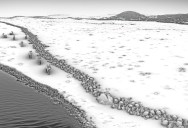
According to a recent statement from the Leibniz Institute for Baltic Sea Research Warnemünde (IOW)’s SEASCAPE project, a kilometer-long stone structure buried under the Baltic Sea is likely to be an ancient man-made hunting site.
Using an interdisciplinary approach, the team are in the process of both scanning, modelling, and understanding the purpose of these mysterious structures, as SEASCAPE’s Jacob Geersen explained in the statement:
“With SEASCAPE, we are breaking new scientific ground, not only in the truest sense of the word below the sea surface, but also through the close collaboration of very different disciplines – geophysics, archaeology and palaeo-environmental research – which are all essential for a meaningful interpretation of the structures.”
IOW
But this Baltic site isn’t the only area of interest for the researchers, who are seeking to understand not only the now-submerged landscapes within which hunter-gatherers lived, but to comprehend more about their lifestyles, social systems and structures.
Thus they are also planning to scan and map potential Stone Age megastructures situated in the Flensburg Fjord and Fehmarn Sound.
A greater understanding of Stone Age hunter-gatherers in the Baltic region will not only tell us more about the environment of the area and how it has changed over time, it will also help us to understand how the society in Northern Europe expanded into what it is today.
Not only this, the potential megastructures may divulge yet more secrets about how those who came before us lived their lives, even in the most extreme conditions.
If you thought that was interesting, you might like to read about why we should be worried about the leak in the bottom of the ocean.





Sign up to get our BEST stories of the week straight to your inbox.
