
Massive Robot Centipedes Could Soon Be Swarming Through Fields Near You

Ground Control Robotics
When you think of farm work, you think of flat land and combine harvesters, people in wide-brimmed hats driving a tractor with a sheepdog running alongside.
But that’s not the reality for some farms, where combine harvesters would uproot precious crops and weeding needs to be done by hand.
When it comes to vine crops like tomatoes or grapes, for example, a different approach is needed to care for the plants and preserve the fruit, which is delicate and prone to damage if handled incorrectly, limiting the possibilities of automation in these farms.
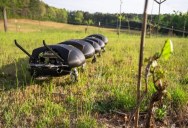
Enter the centipede robot: pioneered by Dan Goldman at Georgia Tech, whose startup Ground Control Robotics (GCR) is currently testing robots modelled on the wiggly, flexible creatures for the management and care of agricultural crops.
Ground Control Robotics
What’s special about these highly moveable robots is their ability to flex around the plants they are caring for: whether they are ground-based or towering vines, on flat land, or on rocky slopes, the centipede robots are able to navigate the terrain to weed and care for the plants, as Goldman explained in an interview with IEEE Spectrum:
“We want to send the robot as close to the crops as possible, and we don’t want a bigger, clunkier machine to destroy those fields.”
Though the development and ultimately purchase of robots is costly, Goldman explains that such ground-breaking technology would save farmers a lot on the long run, since paying employees to carefully pick through the soil around blueberry plants, for example, is extremely costly and time consuming – and the alternative is the heavy use of pesticides, which many farmers and consumers prefer to avoid.
Until this point, this has been a challenge for mechanisation. However, the fascinating upscaling of centipede biology, and its translation to robotics seems to have solved the problem. Thanks to its many legs, the centipede robot can tackle even the most challenging terrain, whilst its mechanical intelligence can help to remove weeds and pests, whilst evaluating the health of the plant itself – all for the downpayment on a robot.
Ground Control Robotics
Whilst the big mechanical bugs haven’t been rolled out on mass scale yet, GCR are currently testing the robots on a farm and a vineyard in Georgia, to fully understand the capabilities and challenges for operating these robots on blueberry and grape farms.
If the results prove highly successful – or at least cost-effective in comparison to human farm workers – it is likely that we will see robot centipedes caring for our crops in swarms in the future.
But their capacity doesn’t stop there, with the hope that in future, these relatively inexpensive robots will be crucial for traversing disaster-struck terrain in relief efforts. They could even have military capabilities in the future.
For now though, the robot centipedes are happily plucking weeds between blueberries in Georgia, with GCR hopeful for what the future may bring.
If you thought that was interesting, you might like to read about a second giant hole has opened up on the sun’s surface. Here’s what it means.





Sign up to get our BEST stories of the week straight to your inbox.
