
Two Massive Galaxy Clusters Collided In The Distant Past And Are Headed Back Toward Each Other For Round Two

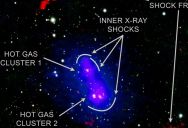
X-ray: NASA/CXC/CfA/Stroe, A. et al.; Optical: PanSTARRS; Radio: ASTRON/LOFAR; Image Processing: NASA/CXC/SAO/N. Wolk
The universe is a massive place that is mostly empty. Even though there are trillions of stars, millions of galaxies, and many galaxy clusters, things are so spread out that collision events are still pretty rare. That is why when a collision occurs in space, it is always interesting enough to catch the attention of astronomers. When the things colliding are galaxy clusters, it is even more incredible.
A galaxy cluster is a massive are where hundreds, or even thousands, of galaxies are present. So, having two separate galaxy clusters on a crash course means that there is a lot that scientists can learn.
That is what is happening with the clusters known together as PSZ2 G181.06+48.47 (a catchy name, right?).
Galaxy clusters on a crash course is interesting enough, but according to combined research from NASA’s Chandra X-ray Observatory, the LOw Frequency ARray (LOFAR) in the Netherlands, and the European Space Agency, this is actually (at least) the second time these two galaxy clusters have collided. It is believed that sometime in the past, these two galaxy clusters collided and continued traveling through and past each other. As they traveled away from each other, the combined gravity of the mass within each cluster slowed them down and will eventually pull them back into another collision course.
Shutterstock
In theory, they will go through each other once again and then ‘bounce’ back and forth like this for many millions, or billions, of years until they eventually settle into being one massive galaxy cluster, but that is a long way off.
Of course, even the actual collision of these two galaxy clusters this time is still a ways off. Even though the clusters are moving fast by our understanding, the distance they have to cover is massive. This does not mean that scientist can’t learn a lot by studying them though. In fact, several papers have already been written on it, including one in a recent issue of The Astrophysical Journal, which took information from a second paper written by Kamlesh Rajpurohit of the Center for Astrophysics | Harvard & Smithsonian (CfA). A third paper was also referenced, led by Eunmo Ahn from Yonsei University.
In the most recent study, a compilation image was released that shows the two clusters along with x-ray shock waves and further out, radio shock fronts. These are the details that were used to determine that the clusters had collided in the past, and that they are on track to do it again in the future.
While very interesting for researchers, this collision will have virtually no impact to us here on Earth (other than from what we can learn about it). The clusters are about 2.8 billion light-years away from us, which makes them great for studying at a very safe distance.
If you thought that was interesting, you might like to read about the mysterious “pyramids” discovered in Antarctica. What are they?





Sign up to get our BEST stories of the week straight to your inbox.
