
First Ever Planet Outside Our Solar System Discovered Using Just James Webb Space Telescope Images

NASA/ESA/CSA/Anne-Marie Lagrange (CNRS, UGA)/Mahdi Zamani (ESA/Webb)
Located around 111 light years away from our solar system, and thus being quite close in space terms, is the star TWA 7.
Also known by the name CE Antilae, TWA 7 is fairly young at around 6.4 million years old (which makes our, only middle-aged, 4.6 billion year old sun look positively geriatric), and has been the source of interest from scientists for quite some time.
But thanks to new observations from astronomers using NASA’s James Webb Space Telescope (JWST), TWA 7 has just got a whole lot more interesting.
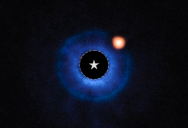
And that’s because, for the very first time, tools on the JSWT have allowed the astronomers to discover a brand new planet – one that is orbiting TWA 7 – just by photographing it.
ESA/Hubble
This landmark discovery of the planet – named TWA 7b – which was recently published in the journal Nature, came after an international team of researchers used JSWT’s Mid-Infrared Instrument (MIRI) to observe TWA 7 and its surrounds.
And then they spotted it: a faint infrared source. Located in a previously located gap in one of three debris disks surrounding TWA 7, the spotted object giving off the infrared waves matched a likely position for a planet orbiting TWA 7, and with the ruling out of other objects from our solar system causing a disturbance, the team were able to hypothesise that this was, indeed a planet.
Not only that, it was the first planet ever spotted using these methods, and the lightest planet ever detected using JWST’s MIRI outside of our own solar system.
Thought to be a young planet, TWA 7b is around the size of Saturn, with a temperature of around 120 degrees Fahrenheit. When confirmed, TWA 7b will not only be a landmark discovery, it will also confirm the hypothesis that the gaps that can be observed in the debris disks around stars can commonly be a sign of a planet.
NASA
It’s not an easy process, but the infrared detection and the correlations with known gaps in TWA 7’s debris disks were sufficient to detect the planet, as the study’s lead author Anne-Marie Lagrange, of the Observatoire de Paris-PSL and Université Grenoble Alpes in France, explained in a JWST statement:
“Our observations reveal a strong candidate for a planet shaping the structure of the TWA 7 debris disk, and its position is exactly where we expected to find a planet of this mass.”
This milestone is thanks to the JSWT MIRI technology that allows astronomers to reduce the glare of the host star sufficiently, so that they can see the objects around it. This technology will continue to benefit not only our understanding of wider space, but our home system, as study co-author Mathilde Malin, from Johns Hopkins University and the Space Telescope Science Institute in Baltimore,
“This observatory enables us to capture images of planets with masses similar to those in the solar system, which represents an exciting step forward in our understanding of planetary systems, including our own.”
It’s also a testament to the continued development of international space exploration equipment, which is allowing us to understand more about the universe than ever before.
If you thought that was interesting, you might like to read about a second giant hole has opened up on the sun’s surface. Here’s what it means.





Sign up to get our BEST stories of the week straight to your inbox.
