
NASA Releases Video Of How Plant Life On The Entire Planet Changes Over The Course Of A Year

NASA
Plants go through cycles based on the time of the year. It can be fun to watch a tree, for example, move from having bare branches in the winter to buds in the spring, full leaves in the summer, colorful leaves that are falling in the fall, and then back to bare branches again for the winter.
In fact, many people will plan entire vacations around watching the leaves of different regions change colors. Of course, not all trees have leaves that change colors. In addition, not all plant life is in the form of trees. No matter what type of plant it is, however, it is going to be making many adjustments based on the seasons, the local weather, and other environmental factors.
Shutterstock
In an effort to track these changes and gain data about the overall health of the plants on Earth, NASA deployed the PACE satellite. PACE stands for Plankton, Aerosol, Cloud, Ocean Ecosystem. While it was originally going to use its hyperspectral lens to monitor the health of plankton in the ocean, it was quickly found that it could be used to monitor plants on land as well.
Thanks to the lens that can look at the planet in over 100 wavelengths of light, this satellite is able to track three distinct pigment levels in plants. These pigments are chlorophyll, anthocyanins, and carotenoids. Morgaine McKibben is the PACE applications lead at Goddard Space Flight Center in Greenbelt, Maryland. She explained:
“Earth is amazing. It’s humbling, being able to see life pulsing in colors across the whole globe. It’s like the overview effect that astronauts describe when they look down at Earth, except we are looking through our technology and data.”
Chlorophyll is, of course, the pigment that makes the plants green. Anthocyanins are the red pigments that can be found in leaves, commonly seen in the fall. Carotenoids are the yellow pigments, which can show up in the fall but are also seen when trees aren’t getting enough water, nutrients, or other things that make it difficult to thrive, even in the summer.
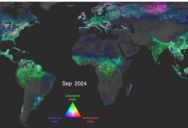
The data from the PACE system was gathered by having the satellite monitor every area of the Earth every few days. From high above the Earth, it could track how much of each of those pigments was present in each area. The data was then used to make a video where the brighter colors represent a higher amount of a given pigment in the area. Researchers can then see how much change there is in a given region.
You can see the video here, showing how the different pigments expand and contract over the seasons:
McKibben talked about what is seen in the video, saying:
“Shifts in these pigments, as detected by PACE, give novel information that may better describe vegetation growth, or when vegetation changes from flourishing to stressed. It’s just one of many ways the mission will drive increased understanding of our home planet and enable innovative, practical solutions that serve society.”
The more researchers can learn about how plants both on land and in the ocean adapt to not just the changing seasons, but also the overall changing environment, will help them to learn how to better protect every ecosystem.
If you thought that was interesting, you might like to read about a quantum computer simulation that has “reversed time” and physics may never be the same.





Sign up to get our BEST stories of the week straight to your inbox.
