
Rabbits With Disturbing Black “Horns” Spotted In The Wild, But Experts Say Not To Worry

Dr. Rachel Ruden/Iowa Department of Natural Resources
AI has become really good at creating images that look authentic, even though the subjects of the pictures are entirely fake. With this in mind, it is completely understandable that when people first started seeing pictures of rabbits with demonic-looking horns growing out of their heads, they assumed that it was fake.
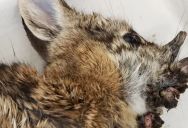
In reality, however, these pictures are actually 100% real and are images of cottontail bunnies that are hopping around in Colorado. The ‘horns’ (also commonly described as tentacles or spikes) are caused by a virus that they are infected with. Local news station 9News interviewed a resident of the area, Susan Mansfield, about one of the rabbits that she saw with her own eyes, which she described in this way:
“It looks like it was black quills or black toothpicks sticking out all around his or her mouth. I thought he would die off during the winter, but he didn’t. He came back a second year, and it grew.”
The Colorado Parks and Wildlife (CPW) department is well aware of the situation, and they have also confirmed that it is real. The experts say that this is caused by rabbit papillomavirus (CTRV), which is a viral infection that can be spread by ticks, mosquitoes, and other insects.
When you see these rabbits in the wild, or even just pictures of them, the first question people ask is whether this disease can spread to humans or their pets (or even other wild animals).
You can see several of the infected rabbits in this news report from FOX31 Denver:
Fortunately, there is no known risk of this happening. The CPW spokesperson, Kara Van Hoose, said the following in an interview with news station KDVR:
“There’s no overt concern needed for pet owners. We would just say to keep those wildlife principles in mind when you do have them out: keep them on leash, keep them away from wild animals just in case, but it is not something necessarily we see transferred from rabbits to dogs.”
The next most common reaction for many people is to assume that hunting these infected rabbits is a good way to stop the virus. The fact is, however, that the virus typically is not deadly to the rabbits, and they will usually recover after a season or two. Once the rabbit overcomes the virus, the growths will slowly fall off.
With this in mind, the CPW is not recommending any rabbit hunts or trapping efforts at this time.
So, at least for now, the residents of Colorado are asked to just leave them alone and hope that these rabbits don’t show up in their nightmares.
If you thought that was interesting, you might like to read about the mysterious “pyramids” discovered in Antarctica. What are they?





Sign up to get our BEST stories of the week straight to your inbox.
