
Soviet Physicist Put His Head Into A Particle Accelerator And Got Struck By A Proton Beam Traveling Nearly The Speed Of Light, And Lived To Talk About It

Moraes and Moura, OrtogOnlineMag, 2025 (CC BY 4.0)
When you work at a facility that operates a particle accelerator, there are lots of rules that need to be followed in order to keep everyone safe and ensure that the equipment does not get damaged. Back in 1978, however, one physicist failed to follow these precautions, but somehow he survived the event.
Physicist Anatoli Bugorski was working at the Institute of High Energy Physics in Protvino. This facility operated a 1.5-kilometer (.9 mile) long particle accelerator, which was called U-70 synchrotron. One day, he put his head into the accelerator and was struck by a high-energy beam, which traveled directly through his head. Amazingly, he not only survived, but is still alive today.
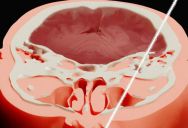
Details of the event are difficult to obtain because of confidentiality requirements at the facility, but recently a team of researchers were able to piece things together enough to create a 3D recreation of how the beam passed through his skull. They wrote up a study on the event, which is published on OrtogOnlineMag.
According to the authors of the study, they had to work off of an old photograph, which showed the path that the beam took. Once they were able to establish exactly how his head was positioned in the photo, they could make a 3D rendering, which showed that the beam passed through Bugorski’s temporal lobe, passing near where it meets up with the occipital lobe.
Shutterstock
The physicist experienced epileptic seizures after the accident, which makes sense given this location.
In addition, the beam went through the bony area near his left ear, causing deafness on that side as well as numbness on on his face. The authors wrote:
“It is noteworthy that, despite the injury occurring in a region associated with language (heard, spoken, and read) in the temporal lobe, and at the boundary with the occipital lobe, related to vision, the accident, apart from the expected fatigue, appears not to have significantly impaired Bugorski’s perception or intellectual faculties.”
Given the fact that the proton beam was traveling at nearly the speed of light makes it astounding that he lived, but that is not all. This beam also exposed him to serious amounts of radiation, estimated to be between 200,000 and 300,000 rads. For context, that is about 600 times more than what is considered a lethal dose. Fortunately, the beam traveled so fast that the exposure was limited in duration.
Not only did Bugorski survive this event, but he actually remained at work after it happened and finished out his day, only seeking medical attention the next day. He was able to get back to work about 18 months later, and completed his PhD after that. Bugorski continued to work there until the age of 77 when he retired.
If you think that’s impressive, check out this story about a “goldmine” of lithium that was found in the U.S. that could completely change the EV battery game.





Sign up to get our BEST stories of the week straight to your inbox.
