
Scientists Locate A ‘Super Earth’ – A Habitable Planet Just Twenty Light Years From Our Own

University of California, Irvine
Generally, scientists agree that the chances of our planet being the only one in the universe that hosts life is highly improbable. And yet, up to this point, despite their best efforts, they have yet to locate any other life forms, besides those hailing from our planet.
But the truth is, this isn’t unexpected, since the universe is huge and thus, other life forms are likely to be very, very far away.
Undeterred, scientists continue to develop more and more powerful technology, in the hope that one day something – or someone – will be detected. And according to a new research paper led by scientists at Penn State, we could be closer than ever.
Pexels
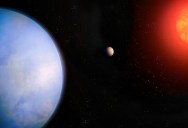
That’s because, as they explain in their study – which was recently published in The Astronomical Journal – brand-new data has helped them to locate a new exoplanet, which they’ve given the catchy name ‘GJ 251 c’.
But more interestingly, this exoplanet – which is situated in a Goldilocks Zone – has been dubbed a “super-Earth”, not only because, at four times the size of our home planet it has a similar rocky surface, but because all the available data suggests it has the capacity to host life.
And what’s more, GJ 251 c is only twenty light years away from Earth, as Penn State’s Suvrath Mahadevan explained in a statement:
“We look for these types of planets because they are our best chance at finding life elsewhere. The exoplanet is in the habitable or the ‘Goldilocks Zone,’ the right distance from its star that liquid water could exist on its surface, if it has the right atmosphere.”
Guðmundur Stefánssonn/Penn State
Why has the planet only just been found? Well, according to Mahadevan, the discovery came as a result of several factors: the development of the Habitable-Zone Planet Finder (HPF) and the Hobby-Eberly Telescope, as well as two years worth of deconstructing this data, and twenty years worth of other records from around the world.
But it still wasn’t easy, with the exoplanet’s star often obscuring it such that computer modelling was required to locate and learn more about the planet – though it still hasn’t been physically seen by the eye, as the University of California, Irvine’s Corey Beard continued:
“We are at the cutting edge of technology and analysis methods with this system. We need the next generation of telescopes to directly image this candidate, but what we also need is community investment.”
As such, the scientists are already forming their plans for when telescope technology advances to the point they require for their future research. Until then, we wait to see whether this ‘super Earth’ could already host life in space.
If you thought that was interesting, you might like to read about a second giant hole has opened up on the sun’s surface. Here’s what it means.





Sign up to get our BEST stories of the week straight to your inbox.
