
Fossil Of 190-Million-Year-Old Ichthyosaur Was Found 24 Years Ago, But When Paleontologists Finally Studied It They Found A New Species

Shutterstock
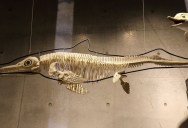
For fossil hunters, locating a well-preserved animal is always exciting, and that was certainly the case when Chris Moore located the intact bones of an ichthyosaur some 24 years ago.
He explained what happened that day:
“I spotted a section of tail vertebrae sticking out and then covered it up and got permission to dig in and have a look at what was there. I followed the vertebrae and which carried on, and then found the rear paddles, and it carried on going: the rib cage was there, the front paddles, and then I got to the skull.”
The bones were found along the Jurassic Coast of the UK, which is known for having lots of incredible fossils. He went on:
“I hit this hard object, which turned out to be the skull, and it was preserved in three dimensions. In most ichthyosaurs, the bones often become flattened and fairly two dimensional, but this had stayed completely in three dimensions. The skull had the two eyes either side, and then this massive, long, sword-like rostrum with hundreds of tiny needle teeth.”
Animals that died in the waters around this area would often fall down onto the seabed. At the time, the mud at the bottom was poisonous, which meant the remains of the animal would be left alone, giving it a good chance of becoming a fossil.
Shutterstock
Once he had the bones completely dug up, he sent them to the Royal Ontario Museum so that they could be studied by Dr. Chris McGowan, who was a leading expert ichthyologist.
Unfortunately, McGowan didn’t take the time to study this specimen, though it is not known why. After he retired, however, Dr. Dean Lomax looked at the fossil and found that it was a new species of ichthyosaur.
There have been many ichthyosaurs found in the past, but none that lived during the Pliensbachian period. Lomax studied these fossils and published his findings in the journal Papers in Palaeontology.
The fossils are still in Ontario, but Moor found another specimen some time later, which is kept at Charmouth Heritage Coast Centre in Dorset, UK, so he has one closer to home.
If you thought that was interesting, you might like to read about the mysterious “pyramids” discovered in Antarctica. What are they?





Sign up to get our BEST stories of the week straight to your inbox.
