
New Study Discovers Weird And Wonderful Creatures Lurking Deep Within Our Oceans

Caladan Oceanic/Inkfish/Minderoo-UWA Deep-Sea Research Centre
It may not feel like it as you wind between high-rise buildings, your soles pounding the pavements between your apartment and your office, but our planet is actually around 71% ocean.
And staggeringly, even after all these years of mapping and diving, over 80% of our planet’s ocean remains unexplored.
There are many factors behind this, most of them logistical, since the depths of the ocean are very deep, very cold, very dark, and very, very high pressure.
Long story short: it’s really not hospitable to human explorers, and even our most robust underwater equipment can have a hard time.
Caladan Oceanic/Inkfish/Minderoo-UWA Deep-Sea Research Centre
As a result, whenever we do manage to explore a new part of the ocean, the results tend to be astounding, with new habitats and new creatures lurking there, waiting to be found.
And new research from The University of Western Australia is no exception. Recently published in the Journal of Biogeography, the study charts the discoveries made during six submersible surveys of deep ocean trenches off the coast of Japan.
Not only did the research map the trenches, they also documented over 30,000 organisms and learned a lot about their habitats, as lead researcher Dr Denise Swanborn explained in a statement:
“This provided one of the most detailed observations of seafloor biodiversity and habitats at these depths. We found differences in community composition and diversity between trenches, linked to depth and nutrient input from surface waters.”
Caladan Oceanic/Inkfish/Minderoo-UWA Deep-Sea Research Centre
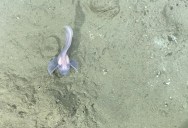
The incredible biodiversity of the trenches allowed researchers to discover everything from sea cucumbers to meadows of sea lilies, the different nutrient levels in different trenches causing them to be home to diverse arrays of deep sea creatures, as Dr Swanborn continued:
“Within trenches, at the same depth band, differences in historical seismic disturbance and seafloor stability created different communities. For example, historically seismically active areas in the Japan Trench were dominated by low-diversity, organisms that had adapted to their environment, while the more stable under-riding slope supported more diverse communities.”
Though they’re elusive – to the extent that many remain entirely unknown – these creatures are vital to life on earth, underpinning vital food chains and even contributing to climate regulation.
And with each new creature discovered, scientists get a little closer to understanding what goes on deep beneath the surface of our oceans.
If you thought that was interesting, you might like to read about why we should be worried about the leak in the bottom of the ocean.





Sign up to get our BEST stories of the week straight to your inbox.
