
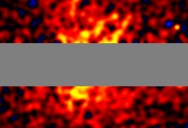
It’s Been Almost A Hundred Years Since We Discovered Dark Matter, And In This Astounding Image We Can ‘See’ It For The First Time

NASA/University of Tokyo/Tomonori Totani
It’s a foundational part of theoretical physics, and dark matter is widely believed to be a kind of scaffolding that holds universes together.
So named because it neither emits light nor absorbs it, dark matter – though considered a fundamental part of our universe – has never been observed in a tangible sense, since we cannot see it.
However, we’ve known about it for almost one hundred years, and attempts to see it have been limited, instead, to discerning its effects on things we can see.
Dark matter, then, can be considered ‘invisible.’ Which makes it all the more impressive that a recent study has allowed us, for the very first time, to see it.
NASA/University of Tokyo/Tomonori Totani
In a recent study, which was published in the Journal of Cosmology and Astroparticle Physics, the University of Tokyo’s Professor Tomonori Totani used NASA’s Fermi Gamma-ray Space Telescope to evidence dark matter for the first time.
Of course, we still cannot see dark matter directly, only its effects. That’s because dark matter is thought to be made up of particles known as WIMPs (weakly interacting massive particles).
One important thing about WIMPs is that when they collide with one another, they are both destroyed and other particles, including gamma ray protons, are released.
And astoundingly, when Professor Totani used the telescope to peer deep into the universe, to areas where dark matter is thought to be concentrated, something incredible happened.
University of Tokyo/Tomonori Totani
As Totani explained in a statement, the telescope allowed him to see not just gamma rays, but a level of gamma-ray emission that was consistent with the intensity of gamma rays predicted to be emitted when WIMPs collide:
“We detected gamma rays with a photon energy of 20 gigaelectronvolts (or 20 billion electronvolts, an extremely large amount of energy) extending in a halolike structure toward the center of the Milky Way galaxy. The gamma-ray emission component closely matches the shape expected from the dark matter halo.”
Though the results require further validation from other researchers, Totani is confident that this discovery will mark a huge step forward in the study of theoretical physics:
“If this is correct, to the extent of my knowledge, it would mark the first time humanity has ‘seen’ dark matter. And it turns out that dark matter is a new particle not included in the current standard model of particle physics. This signifies a major development in astronomy and physics.”
And that milestone will bring us a huge leap forward in our understanding of the universe.
If you thought that was interesting, you might like to read about the mysterious “pyramids” discovered in Antarctica. What are they?





Sign up to get our BEST stories of the week straight to your inbox.
