
New Study Suggests That A 2023 Blast Of Neutrinos May Have Come From A Fading Black Hole, An Event That Was Not Expected To Occur For Billions Of Years

Shutterstock
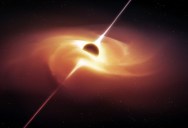
Black holes are known for sucking everything into them, even light. They just keep pulling things into them, growing in mass over time. In addition, however, they are theorized to also emit Hawking radiation, and therefore, they will eventually eject everything they pulled in and therefore die.
That being said, it was assumed that it would take so long for a black hole to die in this way that it would not happen for a very long time. Even the earliest black holes ever created were thought to have a long life ahead of them, meaning none would die until long into the future.
In 2023, however, researchers detected a neutrino blast that was more powerful than anything ever recorded. This blast was called KM3-230213A, and it was 35 times more energetic than then next most powerful thing ever observed.
According to a study conducted by researchers at the University of Massachusetts (UMass) Amherst that was published in Physical Review Letters, that blast may have come from the death of a primordial black hole (PBH).
Primordial black holes were formed immediately after the big bang, and they are far smaller than the black holes that are commonly found at the center of galaxies. There were also a lot of them. If they exist at all.
Shutterstock
PBH’s have not yet been proven to exist, but they do fit in nicely with other theories, so most astronomers agree that they are out there. If they exist and they are sufficiently small, it is entirely possible that they would already start dying. In a statement about the study, Andrea Thamm, a co-author of the research an an assistant professor of physics at UMass Amherst said:
“The lighter a black hole is, the hotter it should be and the more particles it will emit. As PBHs evaporate, they become ever lighter, and so hotter, emitting even more radiation in a runaway process until explosion. It’s that Hawking radiation that our telescopes can detect.”
Just like with stars, once the mass of the PBH dips sufficiently, it could explode very violently, ejecting the remaining mass it has out into the universe with massive amounts of energy. The high-energy particles that are emitted would, according to the study, include neutrinos, which fits what was seen with KM3-230213A.
Not only would the explosion emit neutrinos, however, it could also have a connection with dark matter. Co-author of the study, Michael Baker, an assistant professor of physics at UMass Amherst said:
“There are other, simpler models of PBHs out there. Our dark-charge model is more complex, which means it may provide a more accurate model of reality. What’s so cool is to see that our model can explain this otherwise unexplainable phenomenon.”
Thamm adds:
“A PBH with a dark charge has unique properties and behaves in ways that are different from other, simpler PBH models. We have shown that this can provide an explanation of all of the seemingly inconsistent experimental data.”
Shutterstock
The authors acknowledge that their theories include a lot of unverified possibilities. They rely on the existence of PBH’s, the existence of dark matter, and more. Their study shows, however, that the theory fits what is seen in reality, so they believe it to be accurate.
If correct, they predict that a PBH would die about once every decade, so hopefully additional observations will take place that can help to confirm their findings.
If you thought that was interesting, you might like to read about why we should be worried about the leak in the bottom of the ocean.





Sign up to get our BEST stories of the week straight to your inbox.
