
The T-Rex’s Mouth Is Massive, So How Many Teeth Did It Have? Maybe Not As Many As You Might Think, But They Were Very Large.

Shutterstock
Dinosaurs were huge, and one of the biggest of them was the Tyrannosaurus Rex. This iconic dino has always been considered a giant, but in 2024, a computer modeling study bumped up its estimated size by as much as 70%, making it extraordinarily big.
As an animal gets bigger, it needs to consume more food. Fortunately, as one of the biggest animals of its day, it could eat most anything that it found walking around. This included other large dinosaurs like the triceratops as well as small baby dinosaurs (including baby T-Rex’s). To put it simply, the T-Rex would pretty much try to eat anything it could get its mouth on.
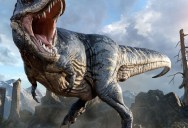
Once it had its mouth on an animal, it did not have much of a chance to survive. The T-Rex is believed to have between 50 and 60 teeth in its mouth, which may not sound like a lot. An adult human, for comparison, has 32 (including wisdom teeth) and in case you didn’t know, human mouths are a lot smaller than that of a T-Rex.
The teeth of a T-Rex, however, were big. Each one was between 19 and 30.5 centimeters (7.5 – 12 inches) long. That’s about the size of a banana. Oh, and the teeth had serrated edges, so they could rip through the flesh of most any animal it was attacking.
Shutterstock
Not only were these teeth big, but they were also very durable. Kristin Brink is a vertebrate paleontologist at the University of Manitoba, and she explained:
“T. rex teeth are more robust than other smaller theropods and could withstand stronger stresses. They were likely able to crush bone, whereas the smaller species likely used their teeth for slicing flesh.”
So, while many dinosaurs evolved with some strong armor for protection, that did not mean that they were invulnerable to a T-Rex attack. The massive king of the dinosaurs would likely have been able to bite through most types of armor without too much trouble.
If it did damage or lose a tooth in the attack, the T-Rex would likely have just grown a new, bigger, one to replace it. While it was once believed that the T-Rex had more teeth when it was younger and lost some as it aged, it turns out that this is likely not true. Brink explains:
“It is possible that tooth count stayed consistent or increased and the teeth got bigger through growth in T. rex, like every other reptile, but we don’t know yet. Reptiles – including dinosaurs – continuously replace their teeth throughout life, so each time they shed their teeth is an opportunity for the next tooth generation to be slightly larger.”
Replacing its teeth as needed means that the T-Rex likely didn’t hold anything back when biting into its prey. It was more than happy to damage a tooth or two in order to get a big meal.
The more we learn about the T-Rex, the scarier it becomes.
If you thought that was interesting, you might like to read about a quantum computer simulation that has “reversed time” and physics may never be the same.





Sign up to get our BEST stories of the week straight to your inbox.
