
New Study Calls Into Question The Widely Held Believe About Why “Magic Mushrooms” Have The Hallusinagentic Psilocybin In Them

Shutterstock
In many ways, evolution is pretty random. There are genetic changes throughout generations of species due to untold numbers of factors, which can cause some results that nobody could predict.
On the other hand, evolution is really good at ensuring that the traits that survive are useful in some ways.
This is especially true when there are examples of convergent evolution, which is when a specific trait evolves in more than one species entirely separately.
For example, eyes have evolved in most animals. The ability to see had to evolve in mammals separately from, for example, insects.
Shutterstock
In this example, it is easy to see (pun intended) the benefits. Just about every species of animal will have an advantage if it is able to visualize the world around it.
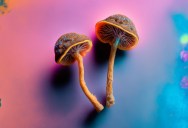
When it comes to mushrooms producing psilocybin (the chemical responsible for hallucinations), however, the evolutionary benefit is not as clear.
The ability to make psilocybin has been documented in at least two entirely unrelated types of mushrooms, however, which is very strong evidance that it isn’t there by ‘mistake.’ Instead, it is almost certain that this trait developed to provide the mushroom a very significant survival advantage.
Scientists who study mushrooms have widely agreed that the survival advantage has to do with deterring the insects that would otherwise eat the mushroom.
Some have suggested that the psilocybin caused a reduced pupation rate for flies, which meant fewer of them eating the mushrooms. Others have said that since the chemical likely causes hallucinations in insects, it may make them more vulnerable to their predators, which also helps to keep their population under control.
A new study, which has yet to be peer reviewed, however, calls much of this into question. The study is available on bioRxiv.
The team of researchers found that wild-growing ‘magic mushrooms’ had RNA sequences for hundreds of different insect proteins, which meant that the insects were all over them, and certainly didn’t avoid them as a meal.
In addition, the bulk of the protein sequences came from fungus gnats, which are known to be a big problem for mushrooms. If the chemical really was a defense mechanism, it wasn’t doing a good job.
They also took Psilocybe cyanescens (a species of mushroom that produces psilocybin) and put it in a jar. Then they had a non-psilocybin-producing mushroom and put it in another jar. The mushrooms were collected from the same area.
After a few days, the team noticed gnat larvae in the jar and then adult flies emerging after about two weeks in both cases.
Shutterstock
While this is a small sample, it does indicate that the psilocybin is not reducing the reproduction rate or survival rate of one of the most significant threats to its survival.
If it turns out that this chemical does not serve as a deterrent, researchers will be back to the drawing board when it comes to figuring out why it has evolved at least twice in mushrooms.
If you found that story interesting, learn more about why people often wake up around 3 AM and keep doing it for life.





Sign up to get our BEST stories of the week straight to your inbox.
