
Astronomers Observe Planet Crashing Into Its Star In An Unexpectedly Violent End To Its Existence

Shutterstock
Our solar system has been around for quite a long time, and barring some unexpected event, it will be here for quite a while to come. Astronomers know, however, that eventually our sun will burn up a sufficient amount of its fuel and it will transition into the end phases of its evolution. When this occurs, it will expand out and become a red giant. When this happens, we better hope that if there are any humans around, they know how to live on another planet or space ships because the Earth will likely be consumed by the sun.
It has long been assumed that stars becoming red giants is a somewhat common way for planets to be destroyed, but it turns out that there may be another cause as well, and astronomers have witnessed it happening through the James Webb Space Telescope (JWST).
In 2023, astronomers had data that suggested that a star that is about 12,000 light years away was going to consume a planet that is roughly the size of Jupiter. This is a great opportunity to witness the event, so they booked time on the JWST to see it happening. When the first images came back, however, they noticed something unexpected.
The star was not a red giant. It was not expanding out to engulf the planet at all. So, the team had to come up with a different theory based on the new data they were able to collect by observing the event.
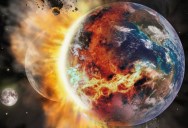
What it seems happened is that this planet was orbiting its sun very closely, possibly even closer than Mercury orbits our own. For some unknown reason, the tidal forces between the two massive objects became imbalanced, so the planet began drifting closer and closer to the star until it actually collided into it.
The team wrote about this event in a new study that has been published in The Astrophysical Journal.
NASA
Morgan MacLeod is a Harvard astrophysicist and a coauthor of the study explained in a statement about the study:
“The planet eventually started to graze the star’s atmosphere. Then it was a runaway process of falling in faster from that moment.”
While the star is far more massive than the planet, it did not walk away from this event unscathed. As the planet came in contact with the outer layers of the star, it was able to eject solar material out away from it, creating a ring of dust encircling the star itself. The study suggests that this area resembles regions in space known as planet-forming regions. This may indicate that similar events might result in the future formations of planets, though additional research would be needed to confirm this would even be possible.
In the end, the study does show that it is at least possible, if not common, for planets to crash into their stars rather than having stars expanding out to engulf a planet.
Either way, the final death of these planets is violent, and very very hot.
If you thought that was interesting, you might like to read about a second giant hole has opened up on the sun’s surface. Here’s what it means.




Sign up to get our BEST stories of the week straight to your inbox.
