
Scientists Are Able To Remotely Control Bees With Newly Developed Technology Connected To Their Brain

shutterstock
When it comes to new technologies these days, they all seem to be focused either on artificial intelligence or robotics. While those two fields certainly have a lot to offer, a team of researchers at the Beijing Institute of Technology decided to combine modern microtechnology with something thousands of years old to accomplish their goals.
What is that ancient tool? A bee.
That’s right, while bees are normally flying around collecting pollen (and sometimes stinging people), these scientists figured out a way to control them so that they can be used as military spies, search and rescue tools, and much more.
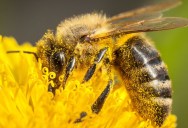
As is reported in the South China Morning Post, the researchers strapped a ‘backpack’ to the bee. This backpack has three tiny needles that pierce into the head of the bee, precisely connecting to its brain. From there, the team sends signals to the backpack, which produces electronic pulses through the needles, forcing the bee to fly forward, backward, right, or left.
Shutterstock
These cyborg bees were reported to obey the desired commands 90% of the time, which is an excellent rate, especially for a first display.
According to the report, the researchers said:
“Insect-based robots inherit the superior mobility, camouflage capabilities and environmental adaptability of their biological hosts.”
It is easy to imagine many ways that something like this could be useful. In spy scenarios, the bees could fly right in without raising any alarms and monitor a situation. Of course, the bees would have to be further equipped with cameras or microphones in order for this to be successful.
Another use for this type of bee would be in search and rescue missions after some type of disaster. Bees can fly into very narrow areas to scout things out and find survivors or inspect the stability of an area.
Of course, the idea of remotely controlled bees is also a little bit terrifying. As of now, the researchers do not have the ability to force the bee to sting someone, but it is likely that this ability is just a matter of improving the design.
Also, bees are just the first insect that they have worked on. According to the report:
“Insect-based robots inherit the superior mobility, camouflage capabilities and environmental adaptability of their biological hosts.”
Shutterstock
It sure sounds like they have plans to expand this technology into other little creatures. One obstacle that they will need to overcome is the weight of the controller. While 74 milligrams isn’t much, it is a lot for a bee (or other insect) to carry. This has to include the battery used to power the device itself and to deliver the shock to the bee’s brain.
Having a battery life long enough for a mission, not to mention powering cameras or microphones, will be difficult to achieve. So, at least for now, there isn’t much to worry about when it comes to an army of remotely controlled insects.
If you thought that was interesting, you might like to read about the mysterious “pyramids” discovered in Antarctica. What are they?





Sign up to get our BEST stories of the week straight to your inbox.
