
America Is Gearing Up For An Invasion Of The Potentially Lethal New Screwworm. What Do You Need To Know?

Shutterstock
The US has just reported its first new case of the flesh eating parasite, “New World Screwworm” (NWS) in nearly a decade, and experts are taking it very seriously. This particular case only made it to the US because a traveler picked it up while traveling to El Salvador, which has an outbreak of this parasite currently, according to US Department of Health and Human Services (HHS) spokesperson, Andrew G. Nixon, in a report to Reuters.
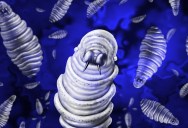
The New World screwworm is the larvae form of the New World screwworm fly (Cochliomyia hominivorax). When the adult fly is ready to reproduce, it will find an animal with some type of open wound and quickly lay its eggs into the wound. Once ready, the eggs will hatch into a tiny larvae.
Those little maggots then burrow deeper into the host, feeding on the healthy flesh and growing along the way. The name comes from the fact that these maggots borrow down in a way similar to how a screw goes into wood. The initial wound, which may have since healed over, starts to grow bigger and deeper.
If left untreated, the wound could become deadly. Fortunately, humans can typically get treatment fairly early on since they will notice the painful wound. Livestock and wild animals, on the other hand, often don’t get any treatment at all until it is too late.
The last time a confirmed case was in the US happened in 2016 in Florida, and before that, there were none since the 1960s when an effort was made to eradicate the pest.
Shutterstock
This eradication was accomplished by breeding sterile male NWS flies into the wild. They will attempt to breed with the wild females, but no offspring can be produced, so the population of the flies drops over time. This eradication project began in 1957, and by 1966, the US confirmed that the NWS was no longer in the country. Mexico went through a similar program and eliminated the NWS by the 1970s.
Unfortunately, other parts of the world did not eradicate this dangerous fly, and now it is spreading once again. Infestations are being tracked and spreading northward. The nearest known infestation is just 595 kilometers (370 miles) away, which was spotted in early July.
The United States is taking this very seriously, especially since it could have a devastating effect on livestock. The USDA explained that the threat was very serious, stating:
“NWS threatens over $100 billion in United States economic activity tied to the cattle and livestock industry alone.”
To start with, the Secretary of Agriculture, Brooke Rollins, issued an order that all ports on the southern border of the US are closed to livestock trade. This is an important step, but it only addresses the potential transmission through infected livestock. Wild animals can also transport the larvae, so more needed to be done.
The USDA announced in June that it would be working at the Moore Air Base in Texas to begin breeding sterile male flies and dispersing them to locations as needed. By the end of this year, the facility is expected to be able to distribute as many as 100 million sterile flies each week.
Similar factories are being set up in Panama and Mexico. The Mexico facility received $21 million in funding from the USDA to help make it able to produce as many as 60-100 million more sterile flies per week.
Once fully operational, this process should be able to help eradicate the NWS from Mexico once again, and push the population further south.
Shutterstock
In addition to this effort, the Food and Drug Administration has been given the authority by the Health and Human Services department to issue Emergency Use Authorizations (EUAs) for drugs to treat or prevent NWS. In a statement from the FDA, it was explained:
“Currently, there are no FDA-approved drugs for NWS in the United States. The FDA through an EUA can authorize the flexible, faster use of certain animal drug products that may be approved for other purposes, or available in other countries, but not formally approved for NWS in the U.S. This ensures veterinarians, farmers, and animal health officials have timely access to the tools they need to protect pets, livestock, and the nation’s food supply.”
These are major steps by the US agencies, which really illustrate just how seriously they are taking the threat of NWS.
If you think that’s impressive, check out this story about a “goldmine” of lithium that was found in the U.S. that could completely change the EV battery game.





Sign up to get our BEST stories of the week straight to your inbox.
