
Microbes That Have Been “Sleeping” For 100+ Million Years Under The Seafloor Wake Up And Start Eating And Reproducing Once Brought To The Surface

Shutterstock
Life in the ocean isn’t easy, even for tiny microbes. Normally, ocean microbes spend their life eating whatever nutrients are in the area and reproducing as an important part of the overall ecosystem. Sometimes, however, debris from the ocean covers them up and traps them in environments with extremely few nutrients and very little oxygen.
For a long time, scientists assumed that the microbes could not survive in such conditions, but a study that was published in the journal Nature Communications found that this is not the case.
For the study, researchers from Japan Agency for Marine-Earth Science and Technology (JAMSTEC) and the University of Rhode Island gathered up samples from 75 meters (246 feet) below the South Pacific Ocean seafloor. This is 5700 meters (18,700 feet) below sea level.
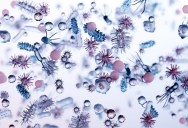
In those samples were a lot of microbes.
Shutterstock
Once the microbes were placed in a lab environment designed for them to thrive, they became metabolically active and even started feeding and dividing. Steven D’Hondt is one of the authors of the study, and a Professor of Oceanography at the University of Rhode Island, and he told IFLScience:
“These are the oldest microbes revived from a marine environment. Even after 100 million years of starvation, some microbes can grow, reproduce, and engage in a wide variety of metabolic activities when they’re returned to the surface world.”
The study showed that life finds a way to survive, even in some of the most extreme and hostile environments in the world. Once a microbe is buried deep under the seafloor, very little oxygen can reach them and almost no nutrients. So, the microbes go into something of an extended hibernation where their metabolism drops to almost zero.
Even microbes that were taken from sediment that was shown to be 101.5 million-years-old became active, and within 68 days had reproduced to the point where there were four orders of magnitude more than they started with. Professor D’Hondt said:
“We believe the community has remained there for 100 million years, with an unknown number of generations. Since the calculated energy flux for subseafloor sedimentary microbes is barely sufficient for molecular repair, the number of generations could be inconceivably low.”
Shutterstock
This proves that microbial life is able to survive for far longer than believed possible, and in conditions that are not at all conducive to life.
While not part of the study, this does make you wonder how long microbes could live on something like an asteroid going through space. Could this explain how life gets seeded to other planets? One can only speculate.
If you thought that was interesting, you might like to read a story that reveals Earth’s priciest precious metal isn’t gold or platinum and costs over $10,000 an ounce!





Sign up to get our BEST stories of the week straight to your inbox.
