
New Research Reveals Family Secrets Of Two Of The Closest Asteroids To Earth

NASA/Southwest Research Institute
For most of us, the subject of asteroids only becomes relevant when they are in close proximity to the earth, or if they – remarkably – crash down in our path.
But there are, in fact, more asteroids – even within the boundaries of our solar system – than we can possibly know, with over a million known asteroids, with these being only the ones that are big enough for us to detect and track.
There’s little need to worry though, since most of the asteroids reside safely in the asteroid belt, located between Mars and Jupiter, meaning that they’re unlikely to ever be on your radar.
Then there are other asteroids, those who have left the asteroid belt – and new research from scientists at the Southwest Research Institute has recently provided surprising new information about two of the closest asteroids to our planet.
NASA/McREL
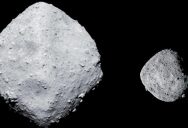
Known as Bennu and Ryugu, these asteroids vary in proximity to our planet, with Bennu coming close to Earth (with close meaning 1.9 million miles away) every six years, and Ryugu coming within 1 million miles of us once a year, thanks to their elliptical orbits.
And since there’s nothing like a nosy neighbor, our Earth-based scientists have collected some juicy gossip about these occasional neighbors, with new spectroscopy data revealing more than ever before about their familial origins, as researcher Dr. Anicia Arredondo explained in a statement:
“Very early in the formation of the solar system, we believe large asteroids collided and broke into pieces to form an ‘asteroid family’ with Polana as the largest remaining body. Theories suggest that remnants of that collision not only created Polana, but also Bennu and Ryugu as well. To test that theory, we started looking at spectra of all three bodies and comparing them to one another.”
Using their combination of lab-based and spacecraft-based data samples, the researchers determined that Bennu and Ryugu were of the same family, meaning that the same collision in early space created the pair – as the researchers explained in a paper recently published by The Planetary Science Journal.
NASA/Southwest Research Institute
Just like human siblings, there are significant differences between Bennu and Ryugu, and also enough to tell them apart from their older sibling, Polana too, as Dr. Tracy Becker explained in the statement:
“Polana, Bennu and Ryugu have all had their own journeys through our solar system since the impact that may have formed them. Bennu and Ryugu are now much closer to the Sun than Polana, so their surfaces may be more affected by solar radiation and solar particles. Likewise, Polana is possibly older than Bennu and Ryugu and thus would have been exposed to micrometeoroid impacts for a longer period. That could also change aspects of its surface, including its composition.”
Whilst Bennu has around a third of a mile in diameter, Ryugu is double Bennu’s size. Their sibling Polana, meanwhile, is 33 miles in diameter, significantly larger than the other two who – thanks to Jupiter’s gravity – she has become separated from.
And despite the distance and difference, the fact that the family resemblance is still clear tells us more about the origins of near-Earth asteroids than ever before.
If you thought that was interesting, you might like to read a story that reveals Earth’s priciest precious metal isn’t gold or platinum and costs over $10,000 an ounce!





Sign up to get our BEST stories of the week straight to your inbox.
