
Researchers Can Measure Important Details In Gravitational Waves From Merging Black Holes, And Can Now Reconstruct The Full 3D Motion Of The Event

Shutterstock
Scientists have been able to measure gravitational waves created by cosmic events for some time, but as the technology improved, they have been able to gather much more detailed information.
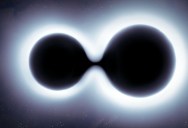
According to a new paper published in the journal Nature Astronomy, a team of astrophysicists have taken this to the next level by being able to measure the recoil that resulted from a new black hole being formed during a merger of two existing ones.
The team was able to measure the ripples in the very fabric of spacetime, which gave them incredible insights into the effects of this merger, which has been named GW190412. During this event, a small(ish) black hole that had a mass of about eight times of our sun merged with one that was about 30 times that of our sun. This event took place approximately 2.4 billion light-years away.
Shutterstock
In a statement about the paper, lead author and University of Santiago de Compostela professor, Juan Calderon-Bustillo, said:
“Black-hole mergers can be understood as a superposition of different signals, just like the music of an orchestra consistent with the combination of music played by many different instruments. However, this orchestra is special: audiences located in different positions around it will record different combinations of instruments, which allows them to understand where exactly they are around it.”
As a result of the merger and this ‘recoil’ from the event, the newly combined black hole accelerated to 31 miles per second. They were also able to determine the direction in which the black hole recoiled (from Earth’s perspective) and the new orbital momentum for the system around it.
This study can now be used to help other researchers get better information about black hole mergers using both the gravitational waves and the electromagnetic signals that are produced. The co-author of the paper, a Chinese University of Hong Kong PhD student, Samson Leong, also added to the statement:
“Black-hole mergers in dense environments can lead to detectable electromagnetic signals —known as flares — as the remnant black hole traverses a dense environment like an active galactic nucleus.”
This is a significant jump in the ability to measure these types of events. Koustav Chandra is another coauthor of the paper, and a Pennsylvania State University astrophysicist who explained in the statement:
“This is one of the few phenomena in astrophysics where we’re not just detecting something — we’re reconstructing the full 3D motion of an object that’s billions of light-years away, using only ripples in spacetime. It’s a remarkable demonstration of what gravitational waves can do.”
Shutterstock
Having the ability to measure these events more precisely can help other scientists to learn more about how the universe formed and continues to evolve through the merging of these black holes.
Thought that was fascinating? Here’s another story you might like: Why You’ll Never See A Great White Shark In An Aquarium





Sign up to get our BEST stories of the week straight to your inbox.
