
How A Mysterious Foot Fossil Pieced Together A Vital Part Of Hominin History

Yohannes Haile-Selassie/Arizona State University
Back in 1974, a surprisingly intact 3.2 million year old Australopithecus afarensis fossil was discovered in Ethipoia.
Named ‘Lucy’, the discovery was groundbreaking, because this hominin fossil was one of the earliest known bipedal examples – in other words, Lucy and her species were among our first upright-walking ancestors.
Thirty-five years after Lucy’s discovery, in 2009 archaeologists and paleontologists from Arizona State University were conducting further excavations in the same area – the Afar Rift in Ethiopia, when they found something.
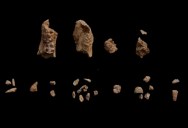
And that something – a hominin foot – that would lead to sixteen further years of painstaking investigations.
Yohannes Haile-Selassie/Arizona State University
Why was this foot so mysterious? Well, it was indisputably a hominin foot, discovered from the same area where Lucy’s Australopithecus afarensis remains were found.
But this foot – named the Burtele Nature Foot – was very different, with an opposable big toe for climbing, suggesting that it used its second toe to push off when walking, unlike Lucy’s species, whose feet were more like our own.
And as Arizona State paleoanthropologist Yohannes Haile-Selassie explained in a statement, this left the researchers in quite a confusing place:
“When we found the foot in 2009 and announced it in 2012, we knew that it was different from Lucy’s species, Australopithecus afarensis, which is widely known from that time. However, it is not common practice in our field to name a species based on postcranial elements –elements below the neck – so we were hoping that we would find something above the neck in clear association with the foot. Crania, jaws and teeth are usually the elements used in species recognition.”
What the team needed, was more evidence – evidence found from the same layer of sediment in the Afar Rift, to prove once and for all that another hominin species coexisted alongside Australopithecus afarensis.
Stephanie Melillo/Mercyhurst University
In 2015, the team were part-way there. They announced the discovery of teeth from a new species, Australopithecus deyiremeda, but couldn’t say for sure whether the Burtele Nature Foot was related.
But then, finally, more and more fossils were recovered from the site, proving once and for all that the foot belonged to the newly-discovered species, and that two bipedal hominin species lived side-by-side in the same region.
As the researchers explain in their study, which was recently published in the journal Nature, this coexistence was in part because of their diets. While both species were largely plant-based feeders, dental analysis proves that Lucy’s species had a more diverse diet, consuming material from tropical grasses and sedges alongside the tree- and shrub-based material that the Burtele species ate.
This, all without pushing either species to extinction. As such a destructive species ourselves, we could learn something from them.
If you thought that was interesting, you might like to read about the mysterious “pyramids” discovered in Antarctica. What are they?





Sign up to get our BEST stories of the week straight to your inbox.
