
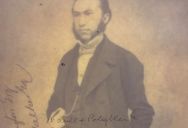
Richard Carrington Witnessed The Most Powerful Solar Event Ever Recorded, And We May Now Have A Photograph Of Him

Image Credit: Royal Astronomical Society
Richard Carrington is an English astronomer who contributed significanlty to our understanding of the sun. He is best known for documenting the Carrington Event in 1859.
This event was the strongest known solar storm. It was so strong that when it hit the Earth, all the telegraph lines were temporarily inoperable due to the intense interference.
In addition, auroras were reported as far south as the Caribbean. There are reports that people could read at night without any additional light source because the auroras were so bright.
Shutterstock
He happened to be observing the sun when it occurred, writing about it:
“In taking my customary observation of the forms and positions of the solar spots, an appearance was witnessed which I believe to be exceedingly rare.”
He went on to explain that he was an:
“…unprepared witness of a very different affair”.
This event was named after him thanks to his observations and reports.
While this is by far his most famous accomplishment, his work also helped to note that the sun has a full rotation on its axis about once every 27 days. He is also one of the first to note that the sun goes through 11-year cycles between the minimum and maximum phases of sunspot activity.
He passed away at his home at the age of 49 due to a cerebral hemorrhage just ten days after his wife died.
His life took place at the earliest times of photography, but up until recently, there were no known photographs of him. This wouldn’t be surprising since getting a portrait done in these early years was costly and time-consuming.
This has led to mistakes (mostly online) where people (and even AI) have used photos of Lord Kelvin and astronomer George Airy claiming that they were Carrington. For many astronomers, this is insulting since both of them had theories that contradicted what Carrington eventually proved to be correct.
Kate Bond is an assistant archivist at the Royal Astronomical Society. While conducting research, she found that Carrington was a member of the Literary and Scientific Portrait Club, which was a group that photographed their members at this time.
The studio that took the pictures was Maull & Polyblank Studio in London. She started looking for pictures from that studio, and eventually found some. She explained that she found some:
“…a photographic shop in the USA […] selling a group of these photographs, and one of them had ‘the late Carrington’ written on it in pencil on the mount.”
She went on:
“I bought it there and then. I thought to myself, ‘If I’m wrong, I’ve just bought another picture of a Victorian man, but if I’m right…’, well, I didn’t want to see that chance slip away.”
Once the photo arrived, she looked at it more closely and found that there was also very faint writing, which prompted her to send it off to the photographic department of the John Rylands Library in Manchester. After analysis, she explained:
“Their opinion is that the lettering was almost certainly written on the back of the print before it was placed in the mount.
Shutterstock
In other words, it was written when the photograph was printed. This matters, because it says: ‘R C Carrington, Esquire for C V Walker, Esquire’. And that was amazing, because CV Walker is Charles Vincent Walker (1812–82), a Fellow of the Royal Society and also a Fellow of the RAS.”
Walker is known to have interacted with Carrington extensively, which is further evidence supporting the claim that this image was indeed of Carrington himself.
The image has now been preserved and is on display at the Royal Astronomical Society, bringing him back home where he belongs.
If you thought that was interesting, you might like to read about a second giant hole has opened up on the sun’s surface. Here’s what it means.





Sign up to get our BEST stories of the week straight to your inbox.
