
Spectacular Night Skies Await The First Visitors To Mars, And Thanks To NASA’s Perseverance Rover, We’ve Got A Sneak Preview

NASA
Day and night work very differently on Mars to what we’re used to on Earth.
A Martian day (known as a ‘sol’) is forty minutes longer than a day on Earth, thanks to the slightly longer time it takes the Red Planet to complete a full rotation, while it orbits the Sun.
So while Martian nights are only twenty minutes longer than Earth nights, the skies look very different on this dusty planet.
With NASA planning to send humans to Mars in the 2030s, it won’t be long before Earth-born people are looking up at Mars’s night skies – but a recent photo sent back by NASA’s Perseverance Rover has sent us a little sneak preview.
NASA/JPL-Caltech
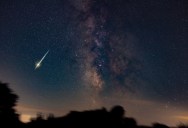
Thanks to Mars’s thin atmosphere, the stars are visible across Mars’s beautiful night skies.
However, that thin atmosphere comes with a big drawback: the cold. Because that atmosphere is so thin, little heat is trapped on the planet (unlike our thicker atmosphere, which acts as a kind of duvet around Earth).
This means that by night Mars is more than a little chilly, dropping as low as -200°F at the poles.
But Perseverance Rover is built to withstand extreme heat and cold, and thus is more than capable of watching the stars from the planet’s desert surface.
Pexels
And when the Rover was stargazing on the night of March 1, 2025, it spotted something spectacular, as NASA explained in a recent statement:
“NASA’s Perseverance rover captured this view of Deimos, the smaller of Mars’ two moons, shining in the sky at 4:27 a.m. local time on March 1, 2025, the 1,433rd Martian day, or sol, of the mission.
In the dark before dawn, the rover’s left navigation camera used its maximum long-exposure time of 3.28 seconds for each of 16 individual shots, all of which were combined onboard the camera into a single image that was later sent to Earth.”
Never Miss a StorySign up to get our BEST stories of the week straight to your inbox.
Of course, Perseverance is no stranger to Deimos. The moon takes 30 hours to orbit Mars, so is frequently visible as it moves slowly through the skies. Even more impressively, it often appears alongside Phobos, Mars’s larger moon, which orbits rapidly – three times a day in total.
But footage of Mars’s spectacular night sky – much less images released on Earth – are rarer, and something to get quite excited about.
If you thought that was interesting, you might like to read about a second giant hole has opened up on the sun’s surface. Here’s what it means.







Sign up to get our BEST stories of the week straight to your inbox.
