
85% Of Life On Earth Was Extinguished During The Ordovician Mass Extinction Period, But The World Recovered Remarkably Quickly

Shutterstock
The Earth has gone through many major events over the course of hundreds of millions of years. Some of the most significant are the six mass extinction events that have occurred. These are times when a huge amount of life has passed away, with many different species of plants, animals, and other living things going extinct.
By far, the most popular one of these is called the K-Pg boundary event, which is when an asteroid collided with the Earth, causing around 3/4 of all plants and animals on the planet to die. This is when the dinosaurs went extinct as well, so it has been cemented in people’s minds through books, movies, TV shows, and even schooling.
About 400 million years before that event, however, another mass extinction event took place that actually killed around 85% of all life on Earth. It is known as the Late Ordovician mass extinction, and as the name implies, it took place during the Late Ordovician period. This is a period when the Earth looked very different than it does today. There were no animals walking the land, and even things like trees and other larger plants did not yet exist.
Nearly all life on Earth was still confined to the oceans. These oceans, however, were absolutely filled with all different types of life. Researchers have found fossils and other evidence that shows that life was evolving very rapidly in the oceans. Richard Twitchett is a Research Leader in the department of Earth Sciences at the UK’s Natural History Museum. He talked with IFLScience about this time period and the mass extinction event, saying:
“There were animals trying to exploit different lifestyles […] but it’s also diversification within body plans that are obviously becoming more successful for these warm Paleozoic seas.”
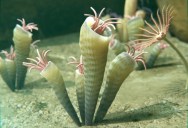
With so much life existing in the oceans, the need to survive pushed animals to evolve more quickly than they did at other times in Earth’s history. If humans were able to go back in time and observe the oceans of the Late Ordovician period, they would see many plants and animals that would look entirely unfamiliar. They would also, however, see the ancient ancestors of some creatures that still exist today. This includes things like corals, sea urchins, starfish, and more.
Shutterstock
Twitchett continued to explain:
“It’s not just species diversity, but it’s also ecological diversity. So, yeah, the Ordovician is a time of huge increasing biodiversity across the planet.”
All good things eventually come to an end. For the dinosaurs, the end came with a massive asteroid and volcanoes. For the Late Ordovician period, it was much less dramatic. The extinction took place over the course of time and in two major stages. First, the Earth’s temperature cooled down significantly, and then after that, the temperature went back up again. The reason for these temperature swings is not 100% known, but Twitchett brought up one of the popular theories:
“There has been a hypothesis that it was the evolution of some of the plants on land that might have caused the drawdown of CO2. And that triggered the glaciation at the end of the Ordovician.”
The temperature swings (potentially among other things) led to the oceans becoming de-oxygenated. This resulted in the widespread die-off that affected plants and animals around the world.
Shutterstock
Interestingly, however, life bounced back shockingly quickly. Twitchett talked about this, saying:
“If we’re just looking at raw numbers – taxa that became extinct, whether we think about families or genera – it’s sitting up there as the second most important [mass extinction] in terms of biodiverse loss. A lot of species, genera, and organisms seemingly became extinct at the time. But if you look at the ecological impacts – the sort of, long-term ecological impact of the events it’s the least important.”
This is because while a huge amount of life was lost, relatively few key groups of life were entirely wiped out. This means that most of the different species of plants and animals on Earth were left with at least a breeding population still alive so that evolution didn’t need to start from scratch, so to speak.
The surviving lifeforms at the time when the temperatures stabilized and the oxygen in the oceans recovered were able to thrive and repopulate their environments quickly. So, while you may not have ever heard about the Ordovician Mass Extinction Event that wiped out 85% of life on Earth, it is still a very interesting period of history that scientists continue to study today.
If you thought that was interesting, you might like to read about a second giant hole has opened up on the sun’s surface. Here’s what it means.





Sign up to get our BEST stories of the week straight to your inbox.
