
Ostriches Are The Largest And Fastest Flightless Bird In The World, And A New Study Suggests That It May Be Because They Have Two Knees On Each Leg

Shutterstock
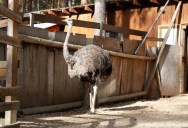
Ostriches are the largest bird in the world, and also the fastest (on land anyway). This seems like a contradiction, but it is true. These birds can run up to 69 kilometers per hour (43MPH) even though they weigh about 130 kilograms (287 pounds). What gives them this amazing ability? It might be something that hasn’t been found in any other animals in the world.
A second set of knees on each leg.
This was studied by a team at the Royal Veterinary College in London using the remains of a deceased ostrich. The team took its legs and analyzed it by bending it and straightening it out as well as using a biplanar fluoroscopy, which let’s them get a visual image of the bones and how they would move if the tissue were still there and alive.
The study found that the upper kneecap is able to alter how much leverage is needed to straighten the leg out. While it requires more force to complete this motion than would be needed with just one knee, the ostrich is able to make the move much more quickly this way.
Shutterstock
The lower knee is a little harder to figure out. The team thinks that it may be there as a protective adaptation. In a study published in the Journal of Experimental Zoology, the authors say:
“Given that both patellae seem to act to increase the speed of knee extension, why then do ostriches have two patellae (rather than one)? It may be that, in addition to its mechanical role as a lever-like sesamoid, the distal patella also reinforces the patellar tendon against compression, particularly the reaction force FR (which, in the largest and fastest living bird, may be substantial). Such a protective function has been proposed for sesamoids and may explain why ostriches are apparently unique in their possession of a second patellar sesamoid. FR increases with increased knee joint flexion, and while ostriches are observed to have less flexed knees compared to other ratites, they also appear to flex their knees faster and over a greater range of motion.”
Additional research will be needed, but their findings would explain how and why the ostrich is able to run so fast while being so large. Given that this is a flightless bird, those two adaptations would be very important for its survival.
Interestingly, most people don’t even know that ostriches have two sets of knees on each leg. For the curious, however, it is not advisable to try to get a good look up close. Ostriches have incredibly powerful kicks that could cause serious damage if you get within range.
If you thought that was interesting, you might like to read a story that reveals Earth’s priciest precious metal isn’t gold or platinum and costs over $10,000 an ounce!





Sign up to get our BEST stories of the week straight to your inbox.
