
Would It Be Possible To Block A Volcano By Plugging It Up With Concrete? Yes, For A While, But The Results Could Be Devastating

Shutterstock
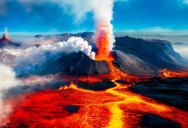
Volcanos are one of the most powerful natural events on Earth. They can release massive amounts of energy in just seconds when they erupt, and if it is an explosive eruption, it can cause devastation to anything living in the region where it occurs. For especially large eruptions, the ash and dust that gets emitted into the air can travel for hundreds of miles causing temperature changes, unhealthy air quality, and many other issue.
So, when thinking about how to protect people from volcanos, it is natural to think about simply plugging them up by dumping concrete into the top. While this may seem like a good idea at first, it is definitely not something that should be done.
To start with, volcanos that have the potential to explosively erupt in a dangerous way are usually quite big. The amount of concrete that would be needed would be massive, and very expensive, and that is ignoring just how difficult it would be to get it safely where it is needed.
More importantly, however, is the fact that it would actually end up making the eruption worse. Explosive eruptions occur when there is a massive buildup of pressure under the ground that cannot escape. Once it hits a sufficient amount, it breaks through the rocky area above it (typically a mountain) in the iconic eruptions that are so famous.
If people found where steam or other gasses were coming out of an active volcano and dumped tons of concrete on top, it would stop those gasses from escaping. While this could delay the eruption for some time, when it did finally erupt, the pressure levels would be higher than if nothing were done, which means the explosion would be significantly greater.
Shutterstock
In addition, most volcanos don’t actually erupt during massive explosions. Instead, as the magma under the ground heats up and becomes thinner, the gasses are able to work their way up and out of the Earth. This keeps the pressure levels relatively low, so an explosion is not possible.
Instead, the lave seeps out of the Earth and flows away at a fairly slow rate. While having lava present can be dangerous to anyone in the area, it is much easier to stay safe when it is moving slowly and predictably than it would be if it were exploding out of the side of a mountain. The US Geological Survey explains it well:
“If magma is thick and sticky, gases cannot escape easily. Pressure builds up until the gases escape violently and explode. Explosive volcanic eruptions can be dangerous and deadly. They can blast out clouds of hot tephra from the side or top of a volcano. These fiery clouds race down mountainsides destroying almost everything in their path.”
If someone did want to use concrete to help with volcano safety, it would be much better to place concrete barriers in the way of the slow moving path of lava to redirect it somewhere that it can’t cause harm. Concrete is a great material for this because its melting point is around 1500° C (2700° F), which is much higher than the temperature of lava, which generally only reaches 871°C (1600° F).
Shutterstock
So, the bottom line is that while a massive amount of concrete on a volcano may hold it back for a while, you definitely don’t want to be around when it finally does erupt.
If you thought that was interesting, you might like to read about a quantum computer simulation that has “reversed time” and physics may never be the same.





Sign up to get our BEST stories of the week straight to your inbox.
