
Ultra-High Resolution Telescope Catches A Glimpse Of Object That May Answer Key Questions About Dark Matter

Shutterstock
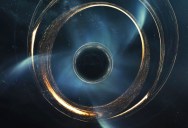
Sufficiently dense objects warp spacetime so that it acts like a lens. If there is a very dense object such as a black hole or large star in the foreground, whatever is shining from behind it (like a galaxy, for example) will have its light magnified from our point of view.
When astronomers were studying an elliptical galaxy called JVAS B1938+666, which is 6.5 billion light-years away, they saw that the light from another galaxy that was more than 11 billion light-years away was being magnified around it.
This alignment provided the astronomers a great opportunity to study this phenomenon, which is known as an Einstein ring. Using a radio wave telescope, they were able to see a thin visible arc. These radio waves are theorized to be from a young supermassive black hole that is actively growing. This growth creates an asymmetry, which is then magnified by the gravitational lens.
All of this was gathered thanks to a system of radio telescopes that is called a Very Long Baseline Interferometry technique. Simply put, if you use two of these telescopes and place them far away from each other, they work as if the telescope itself were as large as the distance between them.
For example, a telescope placed on the coast of California and one placed on the coast of New York would provide the same resolution as a telescope the size of all of America. Quite impressive.
In this case, 22 telescopes were connected across long distances to provide results that are the highest-resolution images of their type ever.
Shutterstock
From that data, the team was able to see in great detail the arc from the gravitational lens. Within that arc was a small, dark object. And by small, they just mean that it was a tiny spec on the arc itself.
In reality, that spec is about 1 million times more massive than our sun. Researchers are hoping that this will be able to help them determine whether dark matter is smoothly distributed, or if it can clump up.
John McKean from the University of Groningen, the University of Pretoria, and the South African Radio Astronomy Observatory put out a statement about this finding, saying:
“From the first high-resolution image, we immediately observed a narrowing in the gravitational arc, which is the tell-tale sign that we were onto something. Only another small clump of mass between us and the distant radio galaxy could cause this.”
The team had to work through massive amounts of data to come to the conclusions that were used to publish the papers. In fact, they published two papers, one that focused on the radio arc itself, and the other on the dark object within the arc.
Shutterstock
These papers were published in the Monthly Notices of the Royal Astronomical Society and Nature Astronomy respectively.
Devon Powell at the Max Planck Institute for Astrophysics commented on the data, saying:
“Given the sensitivity of our data, we were expecting to find at least one dark object, so our discovery is consistent with the so-called ‘cold dark matter theory’ on which much of our understanding of how galaxies form is based. Having found one, the question now is whether we can find more and whether their number will still agree with the models.”
Having the opportunity to make these types of observations has the potential to improve the understanding of many areas of astronomy, including gravity, dark matter, Einstein rings, and more.
If you thought that was interesting, you might like to read about a second giant hole has opened up on the sun’s surface. Here’s what it means.





Sign up to get our BEST stories of the week straight to your inbox.
