
US Government Were Undergoing A Disaster Simulation, But Then A Very Real, Extreme Geomagnetic Storm Hit Earth

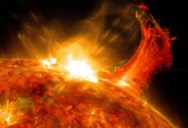
NASA/SDO
On May 10th, 2024, NASA and the US Government were working through an important simulation, to understand how the US would respond to a major disaster.
Why were NASA involved?
Because the threat itself was not a terrestrial one, but one from space.
But then things started to feel very real – because, by some strange coincidence, not long after the simulation started on May 9th, the May 10th geomagnetic storm began, as NASA’s Jamie Favors explained in a statement:
“The plan was to run through a hypothetical scenario, finding where our existing processes worked and where they needed improvement. But then our hypothetical scenario was interrupted by a very real one.”
Pexels
This was highly unusual, and unpredicted for many reasons.
Firstly, the geomagnetic storm was rated G5, or extreme – the highest level geomagnetic storm, and a level that hadn’t been reached in over twenty years.
But twenty years ago, such storms weren’t such an issue, and herein lies the problem and the very reason for the US simulation.
In our modern era, much of our day to day lives – not to mention national and global safety and security measures – are dependent on things like electricity and satellites.
Given geomagnetic storms – especially ones as severe as the May 10th storm, named the Gannon Storm – can cause severe disruptions to satellites and electrical grids, as well as potentially harming astronauts in space, the US government felt it important to prepare to see how their infrastructure could handle such an event.
And as it turned out, there were consequences that even the experts hadn’t predicted.
Pexels
But what is a geomagnetic storm?
Put simply, it’s a disturbance to our magnetosphere (the magnetic field around our planet) caused by solar wind, the particles that radiate from our sun.
In the event of an unusual burst of solar wind, the extreme power can disrupt our planet’s magnetic fields, affecting not only our skies (causing auroras visible at night) but the way in which power and satellite systems operate, as well as potentially exposing astronauts to dangerous levels of radiation.
According to NOAA, these storms can range between G1 (minor storms that cause light fluctuations in power, and potential auroras at high latitudes – think northern Michigan, Maine) to G5 (extreme geomagnetic storms, where there could be blackouts, disruption to navigation and power systems for days, and auroras visible as far south as Florida and Southern Texas).
NOAA
So what actually happened when simulation turned to reality?
As predicted, there were effects to navigation systems, with some GPS-guided tractors failing to correctly plant crops in the Midwest.
Some blackouts resulted from high-voltage lines tripping and transformers overheating, whilst trans-Atlantic flights had to divert because of disruptions to navigation, communication systems, and potentially higher levels of radiation. Disruption and even destruction of some satellites resulted in the days and months following the G5 storm.
Most notable to the rest of the world were the incredible auroras that illuminated skies in the most unlikely of places, thanks to the unusual distribution of oxygen and nitrogen molecules in the upper atmosphere.
Thanks to our preparedness, the repercussions of the storm were quickly rectified, and as the sky became normal once again, day-to-day life resumed.
And as a result of the simulation that quickly became reality, we are more prepared for an extreme geomagnetic storm than ever before.
If you thought that was interesting, you might like to read a story that reveals Earth’s priciest precious metal isn’t gold or platinum and costs over $10,000 an ounce!





Sign up to get our BEST stories of the week straight to your inbox.
